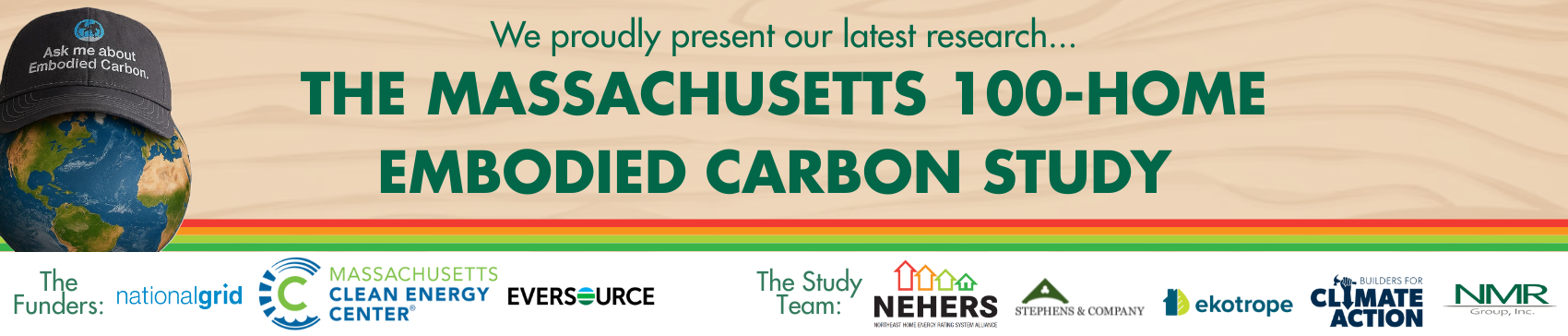
It is our humble pleasure to present the findings of our Massachusetts 100-Home Embodied Carbon Study. We hope this report serves as both a resource and a call to action. Please consider sharing it within your networks and incorporating embodied carbon analysis into your own work — whether you are a designer, builder, rater, policymaker or advocate.
CLICK HERE to read the complete study!
This study is the product of a multiyear collaboration between the Northeast Home Energy Rating System (NEHERS) Alliance, Stephens & Company, Ekotrope, Builders for Climate Action, and NMR Group (hereafter referred to as “the study team”).
The primary goals were to:
- Explore the feasibility of adding embodied carbon analysis to typical operational energy assessments conducted on residential buildings by HERS® Raters.
- Use these augmented energy assessments to explore the feasibility of establishing baseline values for embodied carbon emissions generated by residential new construction in Massachusetts.
Operational emissions refer to the amount of carbon generated by normal building operations, including heating, cooling, lighting, etc. Normally, residential building energy assessments, like the HERS® Index Score, do capture these emissions. Emissions associated with the production, transport, and disposal of the building materials themselves are not included in an operational emissions analysis. These emissions—called embodied carbon emissions—begin to accrue long before a building is constructed or fully operational and represent an unrealized opportunity to capture up-front carbon reductions across all building types. This study focuses on emissions associated with the extraction, transportation to factory, and manufacturing of construction materials (A1–A3 or most “cradle-to-gate” emissions). The study excludes downstream stages such as construction (A4–A5), maintenance (B1–B5), and end-of-life (C1–C4) emissions due to limited data availability and high uncertainty about the quality of available data.
This study is based on an analysis of building construction and mechanical equipment data collected by HERS® Raters at 100 newly constructed single-family homes in Massachusetts. To generate estimates of embodied carbon emissions, the study team took the following steps with the on-site data:
- The study team generated operational energy assessments with Ekotrope, a RESNET®-accredited energy modeling tool widely used by HERS® Raters.
- Those assessments were converted into operational carbon emissions using the National Renewable Energy Laboratory (NREL) Cambium dataset.4
- The team developed an integration worksheet to assist transferring data on building materials from Ekotrope into the Building Emissions Accounting for Materials (BEAM) estimator tool, developed by Builders for Climate Action.
- Participating HERS® Raters received training to use the integration sheet and to collect additional information from building plans required for embodied carbon assessment, which did not require any extra site visits.
- The team combined Mechanical, Electrical and Plumbing (MEP) system data collected at the homes and captured in Ekotrope with MEP system embodied carbon estimates used in the RESNET® 1550 draft standard.5
- All homes followed the projected assessment pathway set by the RESNET® 1550 draft standard, and the team produced embodied carbon estimates with the BEAM calculator.
4This dataset is the basis of the HERS® CO2 Index, which the study team utilizes later in our analysis of the on-site data.
5Table 10.1.5 here: PDS02-RESNETICC1550_webcmnt.docx.
Please stay tuned for additional information that will be coming in 2026 about the publication timeline for RESNET Standard 1550; updates related to software development from BEAM and Ekotrope; and updates about the national pilot program for Embodied Carbon training that RMI is developing for RESNET. If you would like to receive special updates about actions you can take to support these next steps, please email Betsy at betsy@nehers.org and let us know so that we can add you to the list of supporters.
This is an exciting time to be involved in this work! There is still a great deal of work to be done and it will require many people on multiple fronts doing the part that only they can do. We raise our glass to future partnerships and look forward to exploring the synergies that are yet to emerge.